Women beware the 29th of June!
 On this day in 1861, one of the most prominent poets of the Victorian era, wife of poet and playwright Robert Browning, Elizabeth Barrett Browning died in Rome in her husband’s arms at the age of 55. Born 6 March 1806 in Kelloe, Durham, England.
Elizabeth Barrett wrote poetry from the age of eleven. Her mother’s collection of her poems forms one of the largest extant collections of juvenilia by any English writer. At 15 she became ill, suffering intense head and spinal pain for the rest of her life. Later in life she also developed lung problems, possibly tuberculosis. She took laudanum for the pain from an early age, which is likely to have contributed to her frail health.
In the 1840s Elizabeth was introduced to literary society through her cousin, John Kenyon. Her first adult collection of poems was published in 1838 and she wrote between 1841 and 1844, producing poetry, translation and prose. She campaigned for the abolition of slavery and her work helped influence reform in the child labour legislation. Her output made her a rival to Tennyson as a candidate for poet laureate on the death of Wordsworth.
Elizabeth’s volume Poems (1844) brought her success, attracting the admiration of the writer Robert Browning. Their correspondence, courtship and marriage were carried out in secret, for fear of her father’s disapproval. Following the wedding she was indeed disinherited by her father. In 1846, the couple moved to Italy, where she would live for the rest of her life. They had one son, Robert Wiedeman Barrett Browning, whom they called Pen.
Elizabeth’s work had an influence on writers of the day, including Edgar Allan Poe and Emily Dickinson. She is remembered for such poems as “How Do I Love Thee?” (Sonnet 43, 1845) and Aurora Leigh (1856).
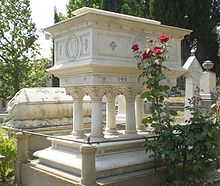 The Final Footprint – Browning said that she died “smilingly, happily, and with a face like a girl’s. … Her last word was—… ‘Beautiful'”. She was entombed in the Protestant English Cemetery of Florence. Browning also noted that on Monday July 1 the shops in the section of the city around Casa Guidi were closed, while Elizabeth was mourned with unusual demonstrations. A collection of her last poems was published by Browning shortly after her death.
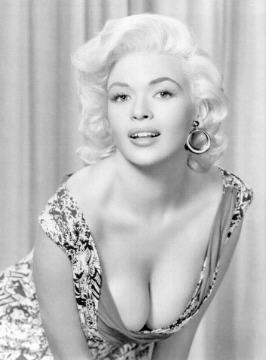 On this day in 1967, Playboy Playmate of the Month, actress, mother of actress Mariska Hargitay, Jayne Mansfield died in an automobile crash on U. S. Highway 90 between Biloxi and New Orleans, at the age of 34. Born Vera Jayne Palmer on 19 April 1933 in Bryn Mawr, Pennsylvania. Perhaps her best known movie roles were: as Jerri Jordan in The Girl Can’t Help It (1956); as Rita Marlowe in Will Success Spoil Rock Hunter? (1957); as Sandy Brooks in Promises! Promises (1963). Well known for her legendary hourglass figure measurements (40-21-35); not so well known for her high IQ measurement (163). She attended the University of Texas at Austin and UCLA and SMU. Mansfield was married three times; Paul Mansfield (1950-1958 divorce), Miklós “Mickey” Hargitay (1958-1964 divorce) and Matt Cimber (1964-1966 filed for divorce) and reportedly had affairs with Robert F. Kennedy and JFK. Mansfield and Hargitay co-authored her autobiography, Jayne Mansfield’s Wild, Wild World.
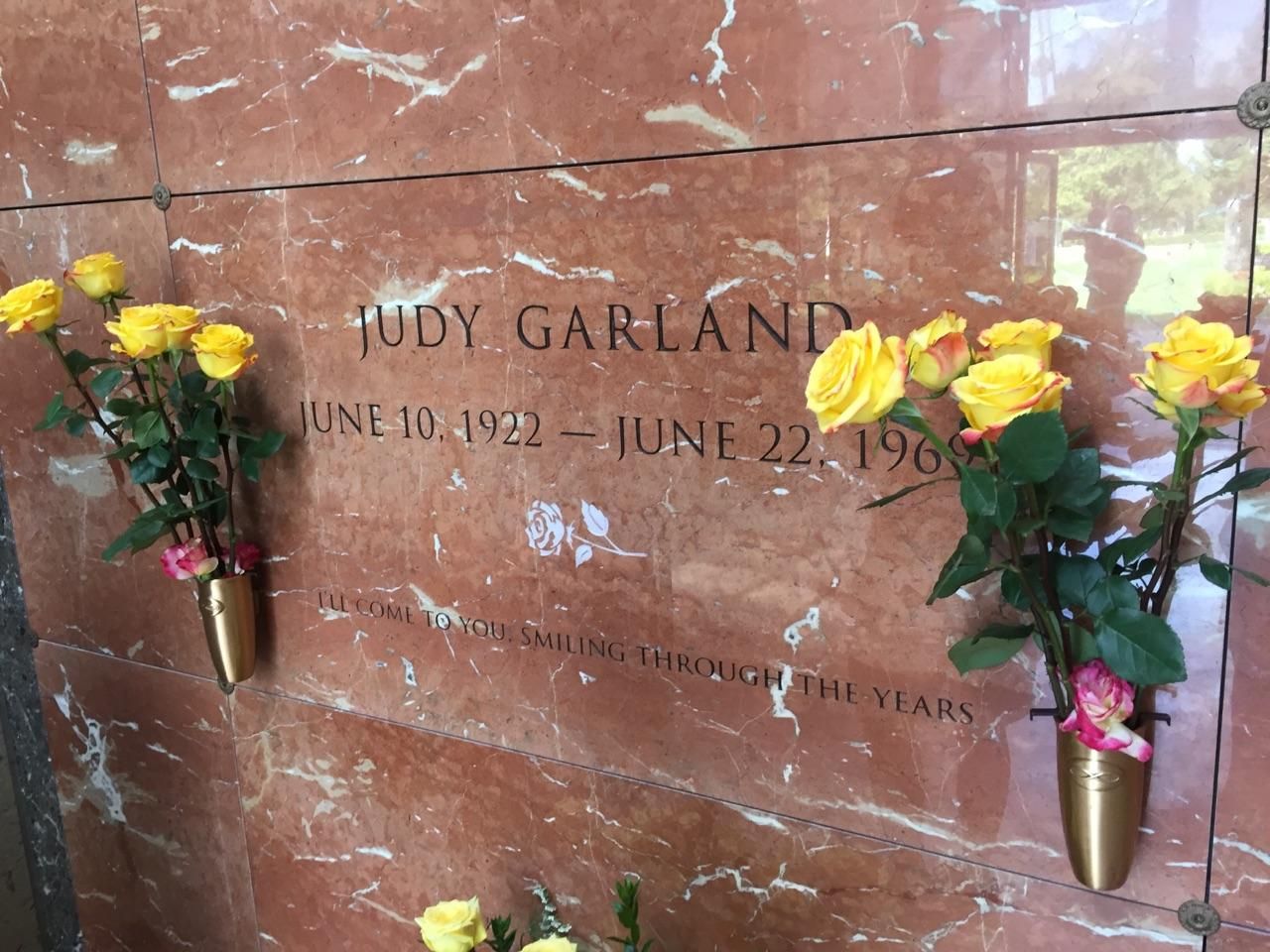
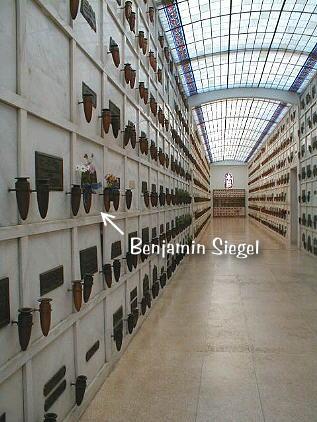
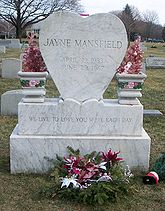 The Final Footprint – Mansfield is interred in Fair View Cemetery in Pen Argyl, Pennsylvania. Her grave is marked by an upright granite marker in the shape of a heart with the inscription; WE LIVE TO LOVE YOU MORE EACH DAY. A memorial cenotaph, showing an incorrect birth year, was erected in the Hollywood Forever Cemetery, Hollywood, California. The cenotaph was placed by The Jayne Mansfield Fan Club. Other notable Final Footprints at Hollywood Forever include; Mel Blanc (yes, his epitaph is “That’s All Folks!”), Chris Cornell, Cecil B. DeMille, Victor Fleming, Judy Garland, Joan Hackett, John Huston, Hattie McDaniel‘s cenotaph, Tyrone Power, Nelson Riddle, Mickey Rooney, Bugsy Siegel, Carl “Alfalfa” Switzer, Rudolph Valentino, Fay Wray, and Anton Yelchin.
 On this day in 1995, actress, Academy Award nominee, Lana Turner died from throat cancer in Century City, California at the age of 74. Born Julia Jean Turner on 8 February 1921 in Wallace, Idaho.
Over the course of her nearly 50-year career, she achieved fame as both a pin-up model and a film actress, as well as for her highly publicized personal life. In the mid-1940s, she was one of the highest-paid actresses in the United States, and one of Metro-Goldwyn-Mayer’s (MGM) biggest stars, with her films earning the studio more than $50 million during her 18-year contract with them.
Born to working-class parents, Turner spent her childhood there before her family relocated to San Francisco. In 1936, when Turner was 15, she was discovered while purchasing a soda at the Top Hat Malt Shop in Hollywood. At the age of 16, she was signed to a personal contract by Warner Bros. director Mervyn LeRoy, who took her with him when he transferred to MGM in 1938. She soon attracted attention by playing the role of a murder victim in her film debut, LeRoy’s They Won’t Forget (1937).
During the early 1940s, Turner established herself as a leading lady and one of MGM’s top stars, appearing in such films as the film noir Johnny Eager (1941); the musical Ziegfeld Girl (1941); the horror film Dr. Jekyll and Mr. Hyde (1941); and the romantic war drama Somewhere I’ll Find You (1942), one of several films in which she starred opposite Clark Gable. Turner’s reputation as a glamorous femme fatale was enhanced by her critically acclaimed performance in the noir The Postman Always Rings Twice (1946), a role which established her as a serious dramatic actress. Her popularity continued through the 1950s in dramas such as The Bad and the Beautiful (1952) and Peyton Place (1957), the latter for which she was nominated for an Academy Award for Best Actress.
Her next film, Imitation of Life (1959), proved to be one of the greatest commercial successes of her career, and her final starring role in Madame X (1966) earned her a David di Donatello Award for Best Foreign Actress. Turner spent most of the 1970s and early 1980s in semi-retirement, making her final film appearance in 1980. In 1982, she accepted a much-publicized and lucrative recurring guest role in the television series Falcon Crest, which afforded the series notably high ratings. My favorite Turner movie is The Postman Always Rings Twice (1946).
Turner married eight times; Artie Shaw (m. 1940; div. 1940), Steve Crane (m. 1942; annul. 1943) (m. 1943; div. 1944), Bob Topping (m. 1948; div. 1952), Lex Barker
(m. 1953; div. 1957), Fred May (m. 1960; div. 1962), Robert Eaton (m. 1965; div. 1969), and Ronald Pellar (m. 1969; div. 1972). In 1958 her teenage daughter Cheryl Crane stabbed Turner’s lover Johnny Stompanato to death in their home during a domestic struggle.
The Final Footprint – Turner was cremated. For her contribution to the motion-picture industry, Turner has a star on the Hollywood Walk of Fame at 6241 Hollywood Boulevard. On May 24, 1950 Lana left hand and footprints in front of the Grauman’s Chinese Theatre.
| Rosemary Clooney | |
|---|---|
 in 1954 |
|
On this day in 2002, singer and actress Rosemary Clooney died from lung cancer at her home in Beverly Hills at the age of 74. Born May 23, 1928 in Maysville, Kentucky. She came to prominence in the early 1950s with the song “Come On-a My House”, which was followed by other pop numbers such as “Botch-a-Me”, “Mambo Italiano”, “Tenderly”, “Half as Much”, “Hey There” and “This Ole House”. She also had success as a jazz vocalist.

With Bing Crosby in White Christmas (1954)

performing in 1977

Screenshot from the trailer of the film Deep In My Heart (1954)
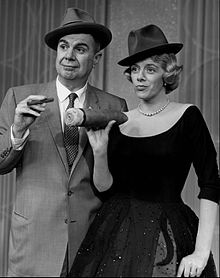
With Ken Murray on The Lux Show Starring Rosemary Clooney (1957)
Clooney was married twice to American movie star José Ferrer, 16 years her senior. Clooney first married Ferrer on June 1, 1953, in Durant, Oklahoma. They moved to Santa Monica, California, in 1954, and then to Los Angeles in 1958. Clooney and Ferrer divorced for the first time in 1961.
Clooney remarried Ferrer on November 22, 1964, in Los Angeles. However, the marriage again crumbled while Ferrer was carrying on an affair with the woman who would become his last wife, Stella Magee. The couple divorced again after she found out about the affair, this time in 1967.
In 1997, she married her longtime friend and a former dancer, Dante DiPaolo at St. Patrick’s Church in Maysville, Kentucky.
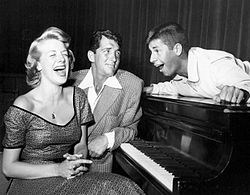
with Dean Martin and Jerry Lewis on TV’s The Colgate Comedy Hour, 1952
The Final Footprint
Her nephew, George Clooney, was a pallbearer at her funeral. She is buried at Saint Patrick’s Cemetery, Maysville.
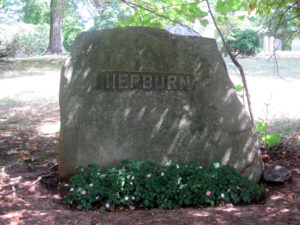
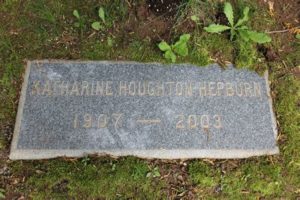
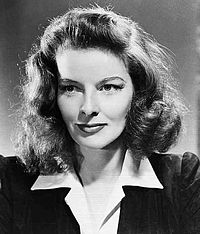 On this day in 2003, actress of film, stage, and television who was known for her headstrong independence and spirited personality, 4x Academy Award winner, Katharine Hepburn died at the Hepburn family home in Fenwick, Connecticut. She was 96 years old. Born Katharine Houghton Hepburn on 12 May 1907 in Hartford, Connecticut. Hepburn’s career as a Hollywood leading lady spanned more than 60 years. Her work came in a range of genres, from screwball comedy to literary drama. Hepburn’s characters were often strong, sophisticated women with a hidden vulnerability. Hepburn famously shunned the Hollywood publicity machine, and refused to conform to society’s expectations of women. She was outspoken, assertive, athletic, and wore trousers before it was fashionable for women to do so. She married once, Ogden Smith (1928 – 1934 divorce), but thereafter lived independently. A 26-year affair with her co-star Spencer Tracy was hidden from the public. With her unconventional lifestyle and the independent characters she brought to the screen, Hepburn came to epitomize the “modern woman” in 20th-century America and helped change perceptions of women. In 1999, she was named by the American Film Institute as the top female Hollywood legend.
The Final Footprint – Hepburn was buried in Cedar Hill Cemetery, Hartford. She requested that there be no memorial service.
#RIP #OTD in 2020 actor (Your Show of Shows, The Dick Van Dyke Show, Ocean’s Eleven), stand-up comedian, director, screenwriter, author Carl Reiner died at his home in Beverly Hills aged 98. Green burial near his home
#RIP #OTD in 2023 actor (Little Miss Sunshine, Russians Are Coming, The Heart is a Lonely Hunter, Argo, Wait Until Dark, Inspector Clouseau, Popi, Catch-22, The In-Laws, Edward Scissorhands, The Rocketeer, Glengarry Glen Ross, Grosse Pointe Blank, Thirteen Conversations About One Thing, Get Smart, Going in Style) Alan Arkin died at his home in San Marcos, California aged 89. Hollywood Forever
Have you planned yours yet?
Follow TFF on twitter @RIPTFF
 On this day in 1880, frontier scout, actor, and cowboy, Texas Jack Omohundro died of pneumonia in Leadville, Colorado at the age of 33. Born John Baker Omohundro on 26 July 1846 in Pleasure Hill, Virginia. In his early teens, he left home, made his way alone to Texas, and became a cowboy. He participated in early cattle drives, notably on the Chisholm Trail. On one drive across Arkansas to meat-short Tennessee, grateful citizens nicknamed him “Texas Jack.” In 1869, he moved to Cottonwood Springs, Nebraska, near Fort McPherson and became a scout and buffalo hunter. There he met William F. “Buffalo Bill” Cody. Together, they participated in Indian skirmishes and buffalo hunts, acted as guides for notables such as the Earl of Dunraven, and led the highly publicized royal hunt of 1872 with Grand Duke Alexei Alexandrovich of Russia and a group of prominent American military figures. Omohundro and Cody traveled to Chicago in December 1872 to debut in The Scouts of the Prairie, one of the original Wild West shows produced by Ned Buntline. Observers described Omohundro as physically impressive and magnetic in personality. He was the first performer to introduce roping acts to the American stage. During the 1873-74 season, Omohundro and Cody invited their friend James Butler “Wild Bill” Hickok to join them in a new play called Scouts of the Plains. On August 31, 1873, Omohundro married Giuseppina Morlacchi, a dancer and actress from Milan, Italy, who starred with him in the Scouts of the Prairie and other shows.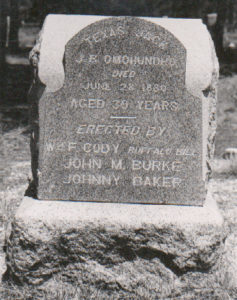
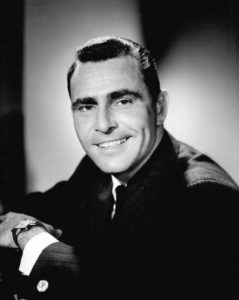 On this day in 1975, United States Army Airborne veteran, screenwriter, novelist, television producer, and narrator Rod Serling died of a heart attack in Rochester, New York at the age of 50. Born Rodman Edward Serling on 25 December 1924 in Syracuse, New York. Perhaps best known for his television series The Twilight Zone and Night Gallery. Serling served as executive producer and head writer for both shows. The Twilight Zone ran on CBS for five years from 1959 to 1964 and featured several young actors who would later become famous including; Ron Howard, Robert Redford, Burt Reynolds, and William Shatner. In my opinion, The Twilight Zone is one of the best shows in the history of television. Serling was married to Carol Serling (1948-1975 his death).
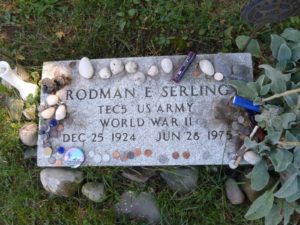 The Final Footprint – Serling is interred in Lake View Cemetery in Interlaken, New York. His grave is marked by an individual engraved granite VA marker. Other notable Final Footprints at Lake View include; 20th President of the United States James A. Garfield; member of The Untouchables, Eliot Ness and John D. Rockefeller.
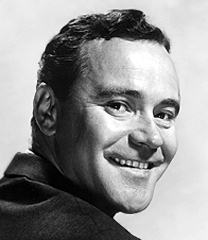 On this day in 2001, United States Navy veteran, Academy Award-winning actor and musician, Jack Lemmon died of colon and bladder cancer in Los Angeles at the age of 76. Born John Uhler Lemmon III on 8 February 1925 in Newton, Massachusetts. Lemmon graduated from Harvard. In my opinion, Lemmon is one the funniest and best film actors. My favorite Lemmon movie roles include; as Jerry “Daphne” in Billy Wilder’s Some Like it Hot (1959) with Marilyn Monroe and Tony Curtis; as Nestor Patou/Lord X in Wilder’s Irma la Douce (1963) with Shirley MacLaine; as Felix Ungar in The Odd Couple (1968) with Walter Mathau and written by Neil Simon; as George Kellerman in The Out-of-Towners (1970), written by Simon; as Jack Godell in The China Syndrome (1979) with Jane Fonda and Michael Douglas; as Shelley Levene in David Mamet’s Glengarry Glenn Ross (1992) with Al Pacino, Alec Baldwin, Ed Harris, Alan Arkin, and Kevin Spacey; as John Gustafson in Grumpy Old Men (1993) with Ann-Margret, Mathau and Burgess Meredith and in the sequel Grumpier Old Men (1995) with Ann-Margret, Sophia Loren, Mathau and Meredith. Lemmon was married twice; Cynthia Stone (1950-1956 divorce) and Felicia Farr (1962-2001 his death).
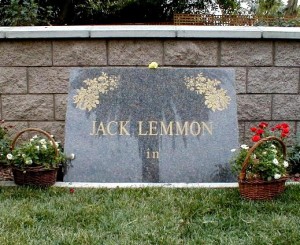 The Final Footprint – Lemmon is interred in a bench estate plot, near his friend Mathau, in Westwood Memorial Park (a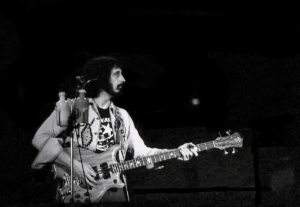
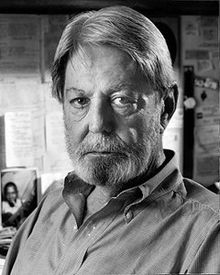



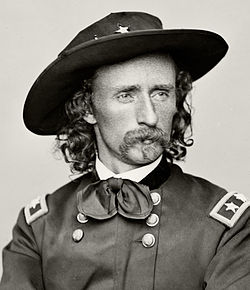
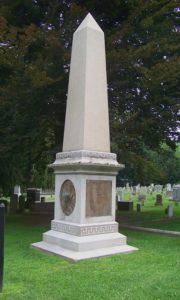
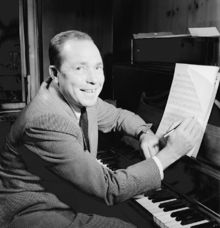
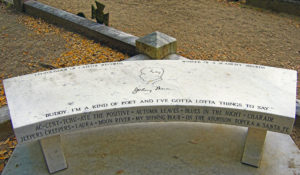
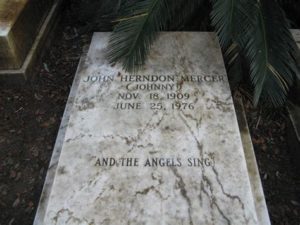 The Final Footprint – Mercer was buried in Savannah’s historic Bonaventure Cemetery. The simple line drawing caricature adorning his memorial bench is in fact a reproduction of a self-portrait. Conrad Aiken is also interred in Bonaventure.
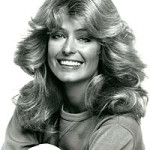 On this day in 2009, University of Texas at Austin attendee, actress and artist, Farrah Fawcett died from anal cancer in the intensive care unit of Saint John’s Health Center in Santa Monica, California, with Ryan O’Neal and Alana Stewart by her side. She was 62. Born Farrah Leni Fawcett on 2 February 1947 in Corpus Christi, Texas. A multiple Golden Globe and Emmy Award nominee, Fawcett rose to international fame when she first appeared as private investigator Jill Munroe in the first season of the television series Charlie’s Angels in 1976. Fawcett later appeared off-Broadway to critical approval and in highly rated and critically acclaimed television movies, in roles often challenging (The Burning Bed; Nazi Hunter: The Beate Klarsfeld Story; Poor Little Rich Girl: The Barbara Hutton Story; Double Exposure: The Story of Margaret Bourke-White) and sometimes unsympathetic (Small Sacrifices). Fawcett was a sex symbol whose iconic poster, released the same year Charlie’s Angels premiered, broke sales records, making her an international pop culture icon. Her hairstyle was emulated by young women in the 1970s and 1980s.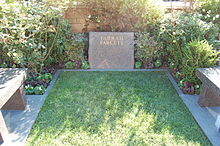
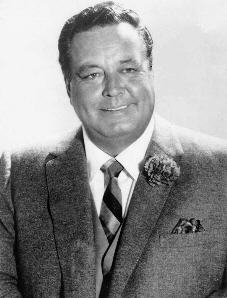 On this day in 1987 comedian, actor and musician Jackie Gleason died at his home in Lauderhill, Florida at the age of 71. Born Herbert Walton Gleason, Jr. on 26 February 1916 in either Bushwick or Bedford-Stuyvesant, Brooklyn. Perhaps best known for his role on television as Ralph Kramden in The Honeymooners and for The Jackie Gleason Show (1952-1970). His most noted film roles were as Minnesota Fats in the drama film The Hustler (1961) starring Paul Newman, and as Buford T. Justice in the Smokey and the Bandit movie series. Gleason married three times; Genevieve Halford (1936-1970 divorce), Beverly McKittrick (1970-1975 divorce) and Marilyn Taylor (1975-1987 his death). His trademark phrases were “And away we go!” and “How sweet it is!”. In my opinion, The Honymooners is, without question, the “Bang, Zoom” funniest show that ever aired on television. And I will stand on Jerry Seinfeld’s coffee table in my cowboy boots and say that. I remember watching The Jackie Gleason Show as a kid. Gleason was hilarious in Smokey and the Bandit.
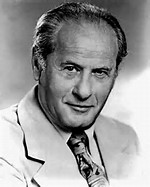 On this day in 2014, actor, graduate of the University of Texas, Eli Wallach died of natural causes at the age of 98 in Manhattan. Born