
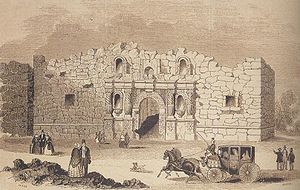
 On this day in 1836, following a 13-day seige, Mexican troops under President General Antonio López de Santa Anna launched a final assault on the Alamo Mission near San Antonio de Béxar (modern-day San Antonio, Texas) killing all but two of the Texian defenders. The Battle of the Alamo was a pivotal event in the Texas Revolution. The Texians under General Sam Houston later defeated Santa Anna and the Mexican Army at the Battle of San Jacinto on 21 April 1836. The Texians’ battle cry that day was “Remember the Alamo” and “Remember Goliad.” The story has been made into two major motion pictures; The Alamo (1960) directed by John Wayne and The Alamo (2004) directed by John Lee Hancock. Among those killed at the Alamo;
-
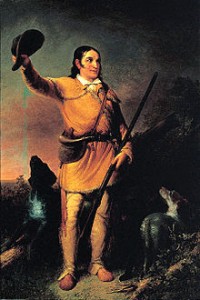
Portrait by John Gadsby Chapman
Davy Crockett – folk hero, frontiersman, soldier, politician, “King of the Wild Frontier”. Born David Crockett on 17 August 1786 in Greene County, Tennessee. Crockett represented Tennessee in the U. S. House of Representatives. When he was narrowly defeated for re-election he said; “I told the people of my district that I would serve them as faithfully as I had done; but if not … you may all go to hell, and I will go to Texas.” Crockett married twice; Polly Finley (1806 – 1815 her death) and Elizabeth Patton (1815 – 1836 his death). Crockett was 49 at the time of his death. Crockett was portrayed in the Alamo films by Wayne and Billy Bob Thornton.
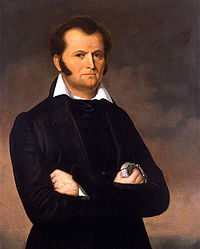 James “Jim” Bowie – pioneer, Texas Ranger and soldier. Born on 10 April 1796 in Logan County, Kentucky. He popularized the Bowie knife. Bowie was 39 at the time of his death. Bowie, Texas and Bowie County are named in his honor. Bowie was portrayed in the Alamo movies by Richard Widmark and Jason Patric.
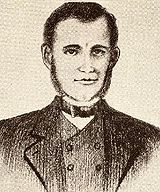 William Barret Travis – lawyer and soldier. Born 9 August 1809 in Saluda County, South Carolina. Travis married once, Rosanno Cato (1828 – 1836 divorce). Travis was 26 years old when he died. Travis was portayed in the Alamo movies by Laurence Harvey and Patrick Wilson. On 24 February 1836, during the siege, Travis wrote the now famous letter addressed “To the People of Texas and All Americans in the World”:
- Fellow citizens and compatriots;
- I am besieged, by a thousand or more of the Mexicans under Santa Anna. I have sustained a continual Bombardment and cannonade for 24 hours and have not lost a man. The enemy has demanded a surrender at discretion, otherwise, the garrison are to be put to the sword, if the fort is taken. I have answered the demand with a cannon shot, and our flag still waves proudly from the walls. I shall never surrender or retreat. Then, I call on you in the name of Liberty, of patriotism & everything dear to the American character, to come to our aid, with all dispatch. The enemy is receiving reinforcements daily and will no doubt increase to three or four thousand in four or five days. If this call is neglected, I am determined to sustain myself as long as possible and die like a soldier who never forgets what is due to his own honor & that of his country. Victory or Death.
- William Barret Travis
- Lt. Col. Comdt.
- P.S. The Lord is on our side. When the enemy appeared in sight we had not three bushels of corn. We have since found in deserted houses 80 or 90 bushels and got into the walls 20 or 30 head of Beeves.Travis
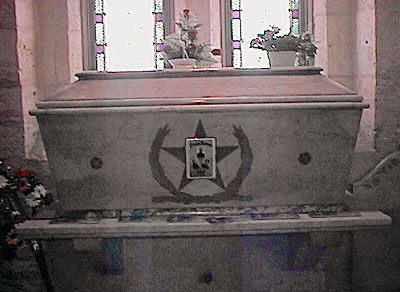 The Final Footprint – the bodies of the Texians including Crockett, Bowie and Travis were stacked and burned. Juan Seguín returned to Béxar in February 1837 to examine the remains and found ashes from the funeral pyres. He had the ashes placed in a simple coffin inscribed with the names Crockett, Bowie and Travis. According to a 28 March 1837 article in the Telegraph and Texas Register, Seguín buried the coffin under a peach tree grove. The spot was not marked and cannot now be identified. However, Seguín later claimed that he had placed the coffin in front of the altar at the San Fernando Cathedral in San Antonio. Remember the Alamo!
#RIP #OTD in 1888 novelist, short story writer, poet perhaps best known as the author of the novel Little Women, Louisa May Alcott died of a stroke in Boston, aged 55. Sleepy Hollow Cemetery in Concord, Mass. near Emerson, Hawthorne, & Thoreau, on a hillside now known as “Authors’ Ridge”
#RIP #OTD in 1973 writer and novelist (The Good Earth) Pearl S. Buck died of lung cancer in Danby, Vermont aged 80. Green Hills Farm in Perkasie, Pennsylvania
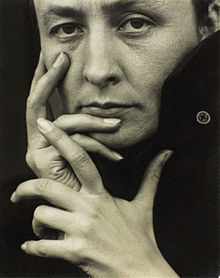
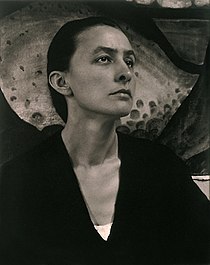
Georgia O’Keeffe, 1918, photograph by Alfred Stieglitz
On this day in 1986, artist Georgia O’Keeffe died in Santa Fe, New Mexico at the age of 98. Born Georgia Totto O’Keeffe on November 15, 1887 in Town of Sun Prairie, Wisconsin. Perhaps best known for her paintings of enlarged flowers, New York skyscrapers, New Mexico landscapes, and the stunning photographs taken of her by Alfred Stieglitz. In my opinion, O’Keeffe is the “Mother of American modernism”.
In 1905, O’Keeffe began her serious formal art training at the School of the Art Institute of Chicago and then the Art Students League of New York, but she felt constrained by her lessons that focused on recreating or copying what was in nature. In 1908, unable to fund further education, she worked for two years as a commercial illustrator, and then spent seven years between 1911 and 1918 teaching in Virginia, Texas, and South Carolina. During that time, she studied art during the summers between 1912 and 1914 and was introduced to the principles and philosophies of Arthur Wesley Dow, who espoused created works of art based upon personal style, design, and interpretation of subjects, rather than trying to copy or represent them. This caused a major change in the way she felt about and approached art, as seen in the beginning stages of her watercolors from her studies at the University of Virginia and more dramatically in the charcoal drawings that she produced in 1915 that led to total abstraction. Alfred Stieglitz, an art dealer and photographer, held an exhibit of her works in 1916. Over the next couple of years, she taught and continued her studies at the Teachers College, Columbia University in 1914 and 1915.
She moved to New York in 1918 at Stieglitz’s request and began working seriously as an artist. They developed a professional relationship—he promoted and exhibited her works—and a personal relationship that led to their marriage in 1924. O’Keeffe created many forms of abstract art, including close-ups of flowers, such as the Red Canna paintings, that many found to represent women’s genitalia, although O’Keeffe consistently denied that intention. The reputation of the portrayal of women’s sexuality was also fueled by explicit and sensuous photographs that Stieglitz had taken and exhibited of O’Keeffe.
O’Keeffe and Stieglitz lived together in New York until 1929, when O’Keeffe began spending part of the year in the Southwest, which served as inspiration for her paintings of New Mexico landscapes and images of animal skulls, such as Cow’s Skull: Red, White, and Blue and Ram’s Head White Hollyhock and Little Hills. After Stieglitz’s death, she lived permanently in New Mexico at Georgia O’Keeffe Home and Studio in Abiquiú, until the last years of her life when she lived in Santa Fe.
In June 1918, O’Keeffe accepted Stieglitz’s invitation to move to New York and accept his financial support. Stieglitz, who was married, moved in with her in July.
In February 1921, Stieglitz’s photographs of O’Keeffe were included in a retrospective exhibition at the Anderson Galleries. Stieglitz started photographing O’Keeffe when she visited him in New York City to see her 1917 exhibition, and continued taking photographs, many of which were in the nude. It created a public sensation. When he retired from photography in 1937, he had made more than 350 portraits of her. In 1978, she wrote about how distant from them she had become, “When I look over the photographs Stieglitz took of me—some of them more than sixty years ago—I wonder who that person is. It is as if in my one life I have lived many lives.”
In 1924, Stieglitz was divorced from his wife Emmeline, and he married O’Keeffe. For the rest of their lives together, their relationship was, “a collusion… a system of deals and trade-offs, tacitly agreed to and carried out, for the most part, without the exchange of a word. Preferring avoidance to confrontation on most issues, O’Keeffe was the principal agent of collusion in their union,” according to biographer Benita Eisler.
They primarily lived in New York City, but spent their summers at his family home, Oaklawn, in Lake George in upstate New York.
In 1928, Stieglitz had an affair with Dorothy Norman. O’Keeffe began to spend the summers painting in New Mexico in 1929.
In August 1934, she visited Ghost Ranch, north of Abiquiú, for the first time and decided to live there; in 1940, she moved into a house on the ranch property. The varicolored cliffs of Ghost Ranch inspired some of her most famous landscapes. In 1977, O’Keeffe wrote: “[the] cliffs over there are almost painted for you—you think—until you try to paint them.” Among guests to visit her at the ranch over the years were Charles and Anne Lindbergh, singer-songwriter Joni Mitchell, poet Allen Ginsberg, and photographer Ansel Adams.
Stieglitz died on July 13, 1946. She buried his ashes at Lake George. She spent the next three years mostly in New York settling his estate, and moved permanently to New Mexico in 1949, spending time at both Ghost Ranch and the Abiquiú house that she made into her studio.
Gallery

Drawing XIII, 1915, Charcoal on paper, Metropolitan Museum of Art
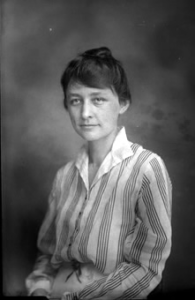
O’Keeffe as a teaching assistant to Alon Bement at the University of Virginia in 1915
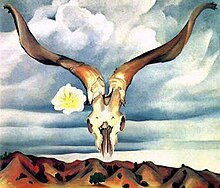
Ram’s Head White Hollyhock and Little Hills, 1935, The Brooklyn Museum
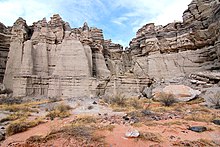
O’Keeffe’s “White Place,” the Plaza Blanca cliffs and badlands near Abiquiú

Alfred Stieglitz, Georgia O’Keeffe, platinum print, 1920
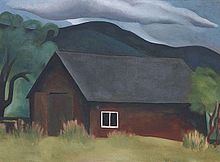
My Shanty, Lake George, oil on canvas, 20 × 27 1/8 in., The Phillips Collection, Washington, D.C.
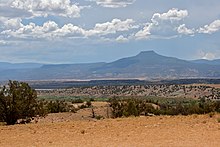
Cerro Pedernal, viewed from Ghost Ranch. This was a favorite subject for O’Keeffe, who once said, “It’s my private mountain. It belongs to me. God told me if I painted it enough, I could have it”
The Final Footprint
Her body was cremated and her cremains were scattered, as she wished, on the land around Ghost Ranch.
 |
|
The Georgia O’Keeffe Museum opened in Santa Fe in 1997. The assets included a large body of her work, photographs, archival materials, and her Abiquiú house, library, and property. The Georgia O’Keeffe Home and Studio in Abiquiú was designated a National Historic Landmark in 1998 and is now owned by the Georgia O’Keeffe Museum.
In 1991, the PBS aired the American Playhouse production A Marriage: Georgia O’Keeffe and Alfred Stieglitz, starring Jane Alexander as O’Keeffe and Christopher Plummer as Alfred Stieglitz.
#RIP #OTD 2013 Canadian country and folk singer-songwriter (“Sudbury Saturday Night”, “Bud the Spud”, “The Hockey Song”) Stompin’ Tom Connors died of kidney failure at his home in Ballinafad, Ontario, aged 77. Erin Union Cemetery in Erin, Ontario
RIP #OTD in 2017 film historian, television presenter, author, actor, primary host for more than 20 years of Turner Classic Movies (TCM), Robert Osborne died at his Manhattan apartment, The Osborne, aged 84. Body donated to Borough of Manhattan Community College
Have you planned yours yet?
Follow TFF on twitter @RIPTFF
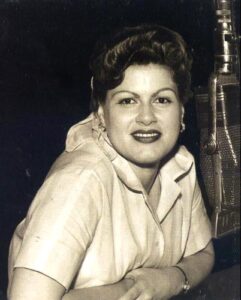 On this day in 1963, country music singer, songwriter, one of the most influential, successful, and acclaimed female vocalists of the 20th century, Patsy Cline, died in a private plane crash near Camden, Tennessee at the age of 30. Born Virginia Patterson Hensley on 8 September 1932 in Winchester, Virginia. In my opinion, the best ever female country music singer and one of my all-time favorite singers. Her contralto voice had such a rich tone and was so emotionally expressive. Her life and career have been the subject of numerous books, movies, documentaries, articles and stage plays. Her hits included “Walkin’ After Midnight”, “I Fall to Pieces”, “She’s Got You”, “Crazy”, and “Sweet Dreams”. A biographical film Sweet Dreams was released in 1985 starring Jessica Lange and Ed Harris. Lange would be nominated for an Academy Award for Best Actress. For all the musical scenes Lange lip-synched to Cline recordings. Cline was married twice; Gerald Cline (1953 – 1957 divorce) and Charlie Dick (1957 – 1963 her death).
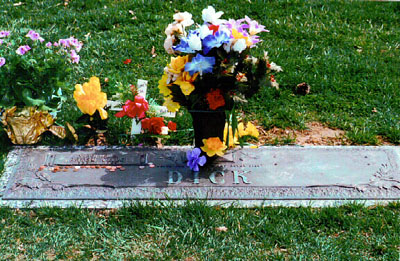 The Final Footprint – Cline is interred in Shenandoah Memorial Park, Winchester, Virginia. Her grave is marked by a companion flat bronze on granite marker with the inscription; “Death Cannot Kill What Never Dies: Love.” A bell tower in her memory at the cemetery, erected with the help of Loretta Lynn and Dottie West, plays hymns daily at 6:00 p.m., the hour of her death. A memorial marks the place where the plane crashed in the still-remote forest outside of Camden, Tennessee.
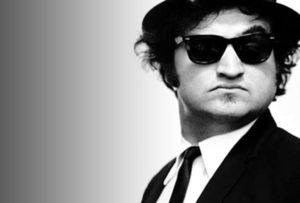 On this day in 1982, comedian, actor, and singer John Belushi died from combined drug intoxication caused by an injection of a heroin and cocaine mixture, known as a speedball at the age of 33 in
 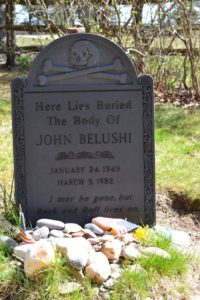 The Final Footprint
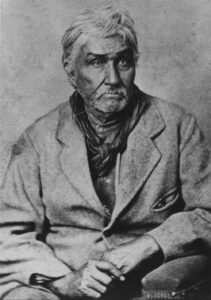 On this day in 1868, Native American Indian trader, guide, and interpreter, Jesse Chisholm, died at Left Hand Spring, near the site of present Geary, Oklahoma from food poisoning. Born in the Hiwassee region of Tennessee, probably in 1805 or 1806. His father, Ignatius, was Scottish and his mother was Cherokee. Primarily known for being the namesake of the Chisholm Trail, which ranchers used to drive their cattle to eastern markets. Chisholm had built a number of trading posts in what is now western Oklahoma. The trail had several variations but
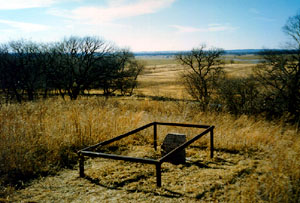 seemed to start at the Rio Grande in Texas and ran though San Antonio and ended in Abilene, Kansas.
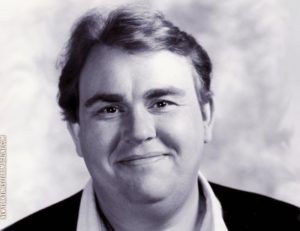 On this day in 1994, comedian and actor John Candy died of a heart attack in Durango, Mexico, aged 43. Born John Franklin Candy on October 31, 1950 in Newmarket, Ontario, Canada. Candy rose to fame as a member of the Toronto branch of the Second City and its related Second City Television series, and through his appearances in such comedy films as Stripes, Splash, Cool Runnings, Summer Rental, Home Alone, The Great Outdoors, Spaceballs, and Uncle Buck, as well as more dramatic roles in Only the Lonely and JFK. One of his most renowned onscreen performances was as Del Griffith, the talkative shower-curtain ring salesman in the John Hughes comedy Planes, Trains and Automobiles.
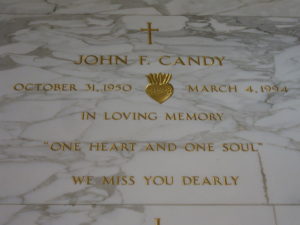 The Final Footprint
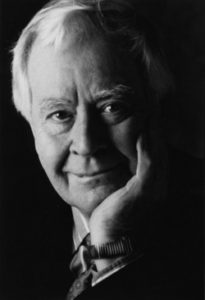 On this day in 2009 playwright and screenwriter Horton Foote died in Hartford, Connecticut at the age of 92. Born Albert Horton Foote Jr. on March 14, 1916 in Wharton, Texas. Perhaps best known for his screenplays for the 1962 film To Kill a Mockingbird and the 1983 film Tender Mercies, and his notable live television dramas during the Golden Age of Television. He received the Pulitzer Prize for Drama in 1995 for his play The Young Man From Atlanta and two Academy Awards, one for an original screenplay, Tender Mercies, and one for adapted screenplay, To Kill a Mockingbird. In 1995, Foote was the inaugural recipient of the Austin Film Festival’s Distinguished Screenwriter Award. In 2000, he was awarded the National Medal of Arts.
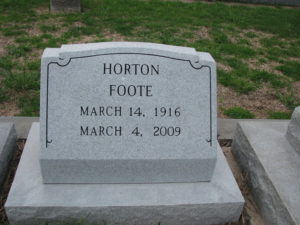 The Final Footprint
 On this day in 2016, author Pat Conroy died in Beaufort, South Carolina from pancreatic cancer at the age of 70. Born Donald Patrick Conroy in Atlanta, Georgia on October 26, 1945. He wrote several acclaimed novels and memoirs. Two of his novels, The Prince of Tides (one of my personal favorites) and The Great Santini, were made into Oscar-nominated films. In my opinion, he is a leading figure of late-20th century Southern literature.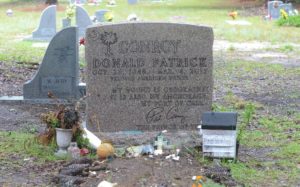
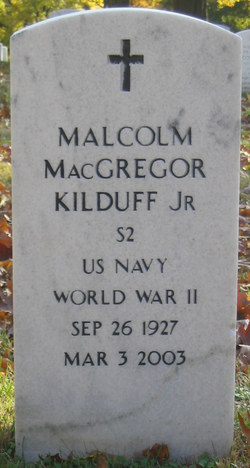
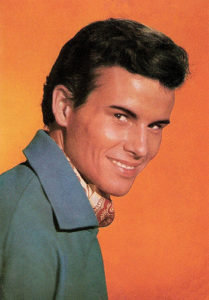 Also on this day in 2003 actor Horst Buchholz died unexpectedly at the age of sixty-nine in the Berlin Charité from pneumonia that developed after an operation for a hip fracture. Born Horst Werner Buchholz on 4 December 1933 . He appeared in more than sixty feature films from 1951 to 2002. During his youth he was sometimes called “the German James Dean.” He is perhaps best known in English-speaking countries for his role as Chico in The Magnificent Seven (1960), as a communist in Billy Wilder’s One, Two, Three (1961) and as Dr. Lessing in Life Is Beautiful (1997).
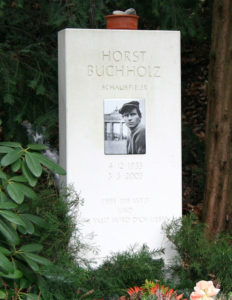 The Final Footprint
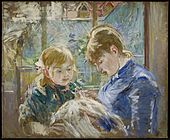
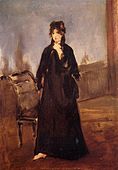
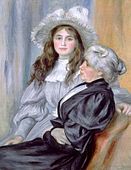
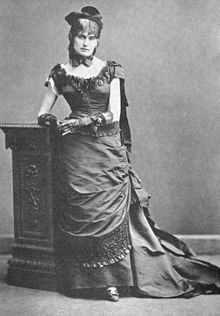 On this day in 1895, painter Berthe Morisot died in Paris, of pneumonia at the age of 54. Born
  The Final Footprint – Morisot is interred in the Cimetière de Passy. Other notable final footprints as Passy include; Claude Debussy, Gabriel Faure, Hubert de Givenchy, Édouard Manet, and Octave Mirbeau.










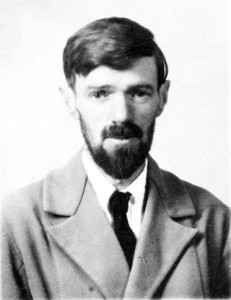 On this day in 1930, novelist, poet, playwright, essayist, literary critic and painter D. H. Lawrence died at the Villa Robermond in Vence, France, from complications of tuberculosis at the age of 44. Born David Herbert Richards Lawrence 11 September 1885 in Eastwood, Nottinghamshire, England. Perhaps best known for his novel, Lady Chatterley’s Lover, first published in 1928. The first edition was printed privately in Florence, Italy; an unexpurgated edition could not be published openly in the United Kingdom until 1960. (A private edition was issued by Mandrake Press in 1929.) The book soon became notorious for its story of the physical (and emotional) relationship between a working class man and an upper class woman, its explicit descriptions of sex, and its use of then-unprintable words.
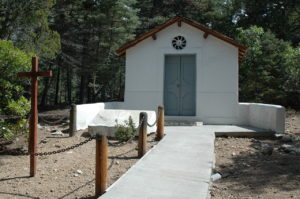 The Final Footprint – Frieda commissioned an elaborate headstone for his grave bearing a mosaic of his adopted emblem of the phoenix. After Lawrence’s death, Frieda lived with Angelo Ravagli on a ranch in Taos, New Mexico and eventually married him in 1950. In 1935 Ravagli arranged, on Frieda’s behalf, to have Lawrence’s body exhumed and cremated. However, upon boarding the ship he learned he would have to pay taxes on the cremated remains, so he instead spread them in the Mediterranean, a more preferable resting place, in his opinion, than a concrete block in a chapel. Some dust and dirt was interred on the Taos ranch in a small chapelhis ashes brought back to the D. H. Lawrence Ranch, east of Taos, New Mexico, to be interred there in a small chapel.
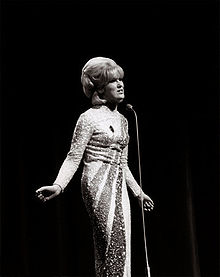 On this day in 1999, British pop singer, “The White Queen of Soul”, Dusty Springfield, died in Henley-on-Thames, Oxfordshire, England from cancer at the age of 59. Born Mary Isobel Catherine Bernadette O’Brien on 16 April 1939 in West Hampstead, North London to an Irish Catholic family. Her voice was distinctively sensual and soulful. My favorite Springfield album is Dusty in Memphis and of course my favorite song from that album is “Son of a Preacher Man.”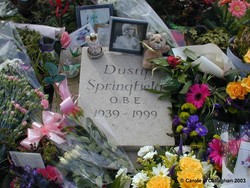

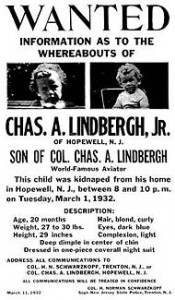 On this day in 1932, the 20 month old son of Charles Lindbergh, Charles Augustus Lindbergh, Jr., was kidnapped and murdered in Hopewell, New Jersey. Born on 22 June 1930 in Englewood Bergen, New Jersey. In what came to be referred to as “The Crime of the Century”, the boy was abducted from his family home in East Amwell, New Jersey, near the town of Hopewell, New Jersey, on the evening of 1 March 1932. His body was discovered a short distance from the Lindberghs’ home on 12 May 1932. A medical examination determined that the cause of death was a massive skull fracture. After an investigation that lasted more than two years and was ostensibly run by New Jersey State Police superintendent Colonel Herbert Norman Swarzkopf, the father of the future General H. Norman Swarzkopf, Jr., Bruno Richard Hauptmann was arrested and charged with the crime. Hauptmann was found guilty of murder in the first degree and sentenced to death. He was executed by electric chair at the New Jersey State Prison on 3 April 1936, at 8:44 in the evening. Hauptmann proclaimed his innocence to the end. Newspaper writer H. L. Mencken called the kidnapping and subsequent trial “the biggest story since the Resurrection”. The crime spurred Congress to pass the Federal Kidnapping Act, commonly called the “Lindbergh Law”, which made transporting a kidnapping victim across state lines a federal crime.
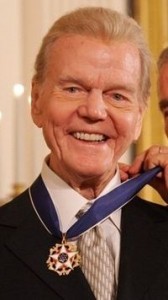 On this day in 2009, radio broadcaster, Paul Harvey, died in Phoenix, Arizona at the age of 90. Born Paul Harvey Aurandt on 4 September 1918 in Tulsa, Oklahoma. He broadcast News and Comment on weekday mornings and mid-days, and at noon on Saturdays, as well as his famous The Rest of the Story segments. His listening audience was estimated, at its peak, at 24 million people a week. Paul Harvey News was carried on 1,200 radio stations, 400 Armed Forces Network stations and 300 newspapers. Harvey was noted for his folksy delivery and his dramatic pauses and quirky intonations. He explained his relationship with his sponsors, saying “I am fiercely loyal to those willing to put their money where my mouth is.” Harvey was married to Lynne “Angel” Cooper (1940 – 2008 her death).
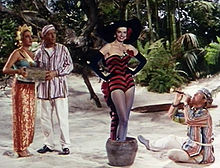
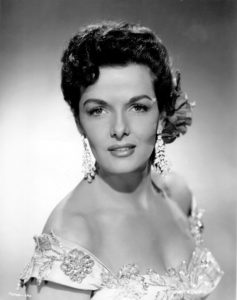 On this day in 2011 actress Jane Russell died at her home in Santa Maria of a respiratory-related illness at the age of 89. Born Ernestine Jane Geraldine Russell on June 21, 1921 in Bemidji, Minnesota. She was one of Hollywood’s leading sex symbols in the 1940s and 1950s.


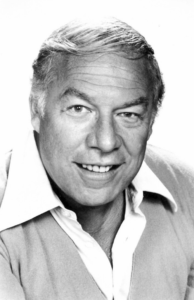 On this day in 2016, United States Army veteran, actor George Kennedy died of a heart ailment at an assisted living facility in Middleton, Idaho, ten days after his 91st birthday. Born George Harris Kennedy Jr. on February 18, 1925 in New York City. Kennedy appeared in more than 200 film and television productions. He played “Dragline” opposite Paul Newman in Cool Hand Luke (1967), winning the Academy Award for Best Supporting Actor for the role and being nominated for the corresponding Golden Globe. He received a second Golden Globe nomination for portraying Joe Patroni in Airport (1970).

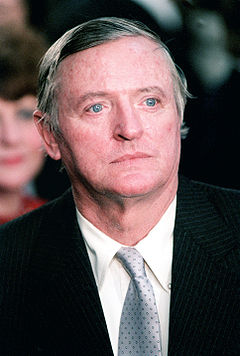
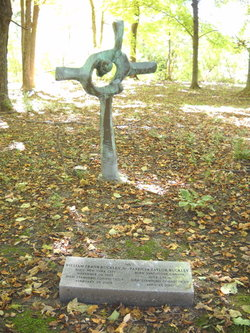
 On this day in 2015, actor, film director, photographer, author, singer, and songwriter, Mr. Spock, Leonard Nimoy died of complications from COPD at the age of 83, in his Bel Air home. Born Leonard Simon Nimoy on March 26, 1931 in the West End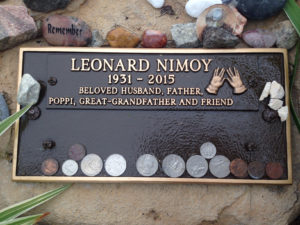
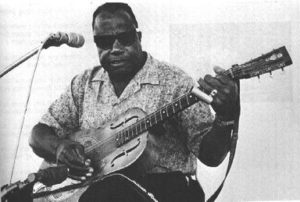
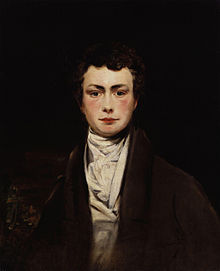 On this day in 1852, poet, singer, songwriter, and entertainer Thomas Moore died being cared for by his wife at Sloperton Cottage, Bromham, Wiltshire, England at the age of 72. Born at 12 Aungier Street in Dublin, over his father’s grocery shop, his father being from the Kerry Gaeltacht and his mother, Anastasia Codd, from Wexford. Perhaps best remembered for the lyrics of “The Minstrel Boy” and “The Last Rose of Summer”. He was responsible, with John Murray, for burning Lord Byron‘s memoirs after his death, at the urging of Byron’s family. In his lifetime he was often referred to as Anacreon Moore. Moore married an actress, Elizabeth “Bessy” Dyke. Moore is often considered Ireland’s National Bard.
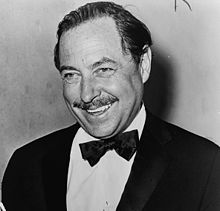 On this day in 1983, playwright, two-time Pulitzer Prize winner, Tony winner, Tennessee Williams, died from an overdose of barbiturates in his suite at the Hotel Elysée in New York City at the age of 71. Born Thomas Lanier Williams on 26 March 1911 in Columbus, Mississippi. Oh my, where to begin. Clearly one of my favorite writers. If I were suddenly limited to having one book, I would probably choose a book of his collected plays. In my opinion, no one ever wrote better dialogue. Every year on his birthday I read one of his plays. Williams moved from St. Louis to New Orleans in 1939 and changed his first name to “Tennessee”, his father’s birthplace. He won the Pulitzer Prize for Drama for A Streetcar Named Desire in 1948 and for Cat on a Hot Tin Roof in 1955. His 1952 play The Rose Tattoo received the Tony Award for best play. His play The Glass Menagerie was adapted into a film in 1950 starring Jane Wyman and Kirk Douglas. A Streetcar Named Desire was adapted into a film in 1951 starring Vivien Leigh, Kim Hunter, Marlon Brando and Karl Malden. The film was nominated for 12 awards and won four at the 24th Academy Awards; Actress in a Leading Role (Leigh), Actor in a Supporting Role (Malden), Actress in a Supporting Role (Hunter) and Art Direction. Cat on a Hot Tin Roof was adapted into a film in 1958 starring Elizabeth Taylor and Paul Newman. Williams said: “A high station in life is earned by the gallantry with which appalling experiences are survived with grace.” And: “Make voyages. Attempt them. There’s nothing else.”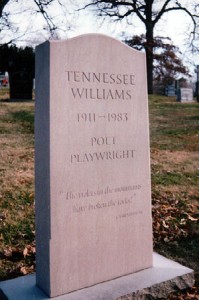


 The Final Footprint

