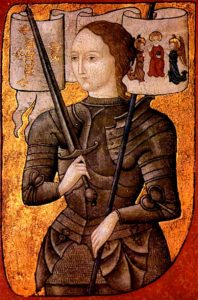
 On this day in 1431, peasant girl, national heroine of France, Catholic saint, The Maid of Orléans, Saint Joan of Arc was executed by burning in Rouen, France at the age of 19. Born around the year 1412 in Domrémy, a village which was then in the duchy of Bar (later annexed to the province of Lorraine and renamed Domrémy-la-Pucelle).
Joan claimed divine guidance and led the French army to several important victories during the Hundred Years’ War, which paved the way for the coronation of Charles VII. She asserted that she had visions from God that instructed her to recover her homeland from English domination. The uncrowned Charles VII sent her to the siege of Orléans as part of a relief mission. She gained prominence when she overcame the dismissive attitude of veteran commanders and lifted the siege in only nine days. Several more swift victories led to Charles VII’s coronation at Reims and settled the disputed succession to the throne. She was captured by the Burgundians, sold to the English, tried and sentenced by an ecclesiastical court.
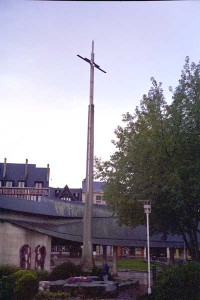 The Final Footprint – Joan’s ashes were cast into the Seine. A monument in Rouen dedicated to her is inscribed with the words of André Malraux: “O Jeanne, without sepulchre, without portrait, you know that the tomb of heroes is the heart of the living.” A statue in her honor was erected in the Notre Dame de Paris Cathedral, interior. Twenty-five years after the execution, Pope Callixtus III examined the trial, pronounced her innocent and declared her a martyr. Joan of Arc was beatified in 1909 and canonized in 1920. She is one of the patron saints of France, along with St. Denis, St. Martin of Tours, St. Louis IX, and St. Theresa of Lisieux.
Down to the present day, Joan of Arc has remained a significant figure in Western culture. From Napoleon onward, French politicians of all leanings have invoked her memory. Writers and composers who have created works about her include: Shakespeare (Henry VI, Part 1), Voltaire (see below) (The Maid of Orleans poem), Schiller (The Maid of Orleans play), Verdi (Giovanna d’Arco), Tchaikovsky (The Maid of Orleans opera), Mark Twain (Personal Recollections of Joan of Arc), and George Bernard Shaw. Depictions of her continue in film, theatre, television, video games, music and performance.
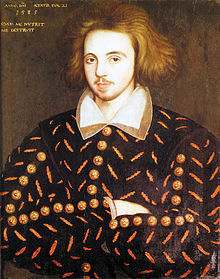 On this day in 1593, playwright, poet and translator of the Elizabethan era, Kit Marlowe, Christopher Marlowe, died in Deptford, Kent, England at the age of 29. Baptised 26 February 1564 in Canterbury, Kent, England. Marlowe was the foremost Elizabethan tragedian of his day. He greatly influenced William Shakespeare, who was born in the same year as Marlowe and who rose to become the pre-eminent Elizabethan playwright after Marlowe’s mysterious early death. Marlowe’s plays are known for the use of blank verse and their overreaching protagonists.
A warrant was issued for Marlowe’s arrest on 18 May 1593. No reason was given for it, though it was thought to be connected to allegations of blasphemy—a manuscript believed to have been written by Marlowe was said to contain “vile heretical conceipts”. On 20 May, he was brought to the court to attend upon the Privy Council for questioning. There is no record of their having met that day, however, and he was commanded to attend upon them each day thereafter until “licensed to the contrary”. Ten days later, he was stabbed to death by Ingram Frizer. Whether or not the stabbing was connected to his arrest remains unknown.
Marlowe’s first play performed on the regular stage in London, in 1587, was Tamburlaine the Great, about the conqueror Timur (Tamerlane), who rises from shepherd to warlord. It is among the first English plays in blank verse, and, with Thomas Kyd’s The Spanish Tragedy, generally is considered the beginning of the mature phase of the Elizabethan theatre. Tamburlaine was a success, and was followed with Tamburlaine the Great, Part II.
The two parts of Tamburlaine were published in 1590; all Marlowe’s other works were published posthumously. The sequence of the writing of his other four plays is unknown; all deal with controversial themes.
- The Jew of Malta (first published as The Famous Tragedy of the Rich Jew of Malta), about the Jew Barabas’ barbarous revenge against the city authorities, has a prologue delivered by a character representing Machiavelli. It was probably written in 1589 or 1590, and was first performed in 1592. It was a success, and remained popular for the next fifty years. The play was entered in the Stationers’ Register on 17 May 1594, but the earliest surviving printed edition is from 1633.
- Edward the Second is an English history play about the deposition of King Edward II by his barons and the Queen, who resent the undue influence the king’s favourites have in court and state affairs. The play was entered into the Stationers’ Register on 6 July 1593, five weeks after Marlowe’s death. The full title of the earliest extant edition, of 1594, is The troublesome reigne and lamentable death of Edward the second, King of England, with the tragicall fall of proud Mortimer.
- The Massacre at Paris is a short and luridly written work, the only surviving text of which was probably a reconstruction from memory of the original performance text, portraying the events of the Saint Bartholomew’s Day Massacre in 1572, which English Protestants invoked as the blackest example of Catholic treachery. It features the silent “English Agent”, whom subsequent tradition has identified with Marlowe himself and his connections to the secret service. The Massacre at Paris is considered his most dangerous play, as agitators in London seized on its theme to advocate the murders of refugees from the low countries and, indeed, it warns Elizabeth I of this possibility in its last scene. Its full title was The Massacre at Paris: With the Death of the Duke of Guise.
- Doctor Faustus (or The Tragical History of the Life and Death of Doctor Faustus), based on the German Faustbuch, was the first dramatised version of the Faust legend of a scholar’s dealing with the devil. While versions of “The Devil’s Pact” can be traced back to the 4th century, Marlowe deviates significantly by having his hero unable to “burn his books” or repent to a merciful God in order to have his contract annulled at the end of the play. Marlowe’s protagonist is instead carried off by demons, and in the 1616 quarto his mangled corpse is found by several scholars.
The Final Footprint

Marlowe was buried in an unmarked grave in the churchyard of St. Nicholas, Deptford immediately after the inquest, on 1 June 1593.
The mightiest kings have had their minions;
Great Alexander loved Hephaestion,
The conquering Hercules for Hylas wept;
And for Patroclus, stern Achilles drooped.
And not kings only, but the wisest men:
The Roman Tully loved Octavius,
Grave Socrates, wild Alcibiades.

The Muse of Poetry, part of the Marlowe Memorial in Canterbury
A Marlowe Memorial in the form of a bronze sculpture of The Muse of Poetry by Edward Onslow Ford was erected by subscription in Buttermarket, Canterbury in 1891.
In July 2002, a memorial window to Marlowe – a gift of the Marlowe Society – was unveiled in Poets’ Corner in Westminster Abbey.
Come live with me and be my Love,
And we will all the pleasures prove
That hills and valleys, dales and fields,
Or woods or steepy mountain yields.
And we will sit upon the rocks,
And see the shepherds feed their flocks
By shallow rivers, to whose falls
Melodious birds sing madrigals.
And I will make thee beds of roses
And a thousand fragrant posies.
- The Passionate Shepherd to His Love (unknown date)
Che serà, serà:
What will be, shall be.
- Faustus, Act I, scene i, lines 47–58
- Hell hath no limits, nor is circumscrib’d
In one self place; but where we are is hell,
And where hell is, there must we ever be.- Mephistopheles, Act II, scene i, line 118
Was this the face that launch’d a thousand ships,
And burnt the topless towers of Ilium?
Sweet Helen, make me immortal with a kiss!
- Faustus, Act V, scene i, lines 91–93
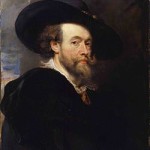 On this day in 1640, Flemish Baroque painter, Pieter Paul Rubens died in Antwerp at the age of 62 from heart failure, which was a result of his chronic gout. born in Siegen in Germany on 28 June 1577.
His unique and popular Baroque style emphasized movement, colour, and sensuality, which followed the immediate, dramatic artistic style promoted in the Counter-Reformation. Rubens specialized in making altarpieces, portraits, landscapes, and history paintings of mythological and allegorical subjects.
In addition to running a large studio in Antwerp that produced paintings popular with nobility and art collectors throughout Europe, Rubens was a classically educated humanist scholar and diplomat who was knighted by both Philip IV of Spain and Charles I of England. Rubens was a prolific artist. The catalogue of his works by Michael Jaffé lists 1,403 pieces, excluding numerous copies made in his workshop. The Museo del Prado owns the largest collection of Rubens’ paintings, and one of the finest as well, and almost all of it comes from Spain’s royal collections.
Gallery
- Early paintings
-

Portrait of a Young Woman with a Rosary, 1609–10, oil on wood, Thyssen-Bornemisza Museum
-

Venus at the Mirror, 1613–14, oil-painting, private collection
-

Diana Returning from Hunt, 1615, oil on canvas, Gemäldegalerie Alte Meister
-

The Rape of the Daughters of Leucippus, c. 1617, oil on canvas, Alte Pinakothek
- Historical portraits
-

Portrait of Marchesa Brigida Spinola-Doria, 1606
-

Portrait of King Philip IV of Spain, c. 1628/1629
-

Portrait of Elisabeth of France. 1628, Kunsthistorisches Museum. Vienna
-

Portrait of Ambrogio Spinola, c. 1627 National Gallery in Prague
- Landscapes
-
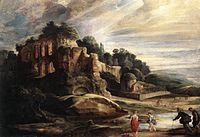
Landscape with the Ruins of Mount Palatine in Rome, 1615
-

Miracle of Saint Hubert, painted together with Jan Bruegel, 1617
-

Landscape with Milkmaids and Cattle, 1618
-

The Château Het Steen with Hunter, c. 1635–1638 (National Gallery, London)
- Mythological
-
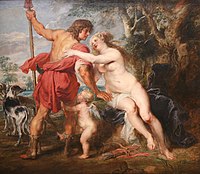
Venus and Adonis
-

Jupiter and Callisto, 1613, Museumslandschaft of Hesse in Kassel
-
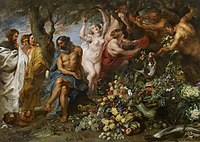
Pythagoras Advocating Vegetarianism, 1618–1630, by Rubens and Frans Snyders, inspired by Pythagoras’s speech in Ovid’s Metamorphoses, Royal Collection.
- Nude
-

Susanna and the Elders, 1608
-

Ermit and sleeping Angelica, 1628
-

Susanna and the elders, Real Academia de Bellas Artes de San Fernando.
- Helena Fourment and related pictures
-

Rubens with Hélène Fourment and their son Peter Paul, 1639, now in the Metropolitan Museum of Art
-

Helena Fourment in Wedding Dress, detail, the artist’s second wife, c. 1630, now in the Alte Pinakothek
-
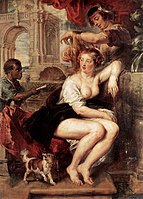
Bathsheba at the Fountain, 1635
-

Pastoral Scene, 1636
-
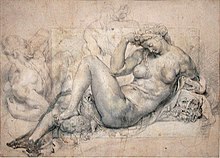
The Night, 1601–1603, black chalk and gouache on paper (after Michelangelo), Louvre-Lens
-
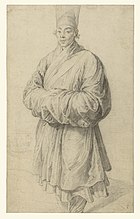
Man in Korean Costume, c. 1617, black chalk with touches of red chalk, J. Paul Getty Museum
-
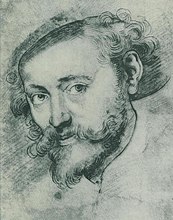
Peter Paul Rubens (possibly his self-portrait), c. 1620s
-
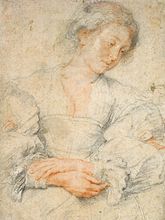
Young Woman with Folded Hands, c. 1629–30, red and black chalk, heightened with white, Boijmans Van Beuningen
-
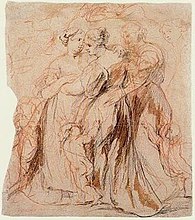
Study of Three Women (Psyche and her sisters), c. 1635, sanguine and ink on paper, Warsaw University Library
-

Study for a St. Mary Magdalen, date unknown, British Museum
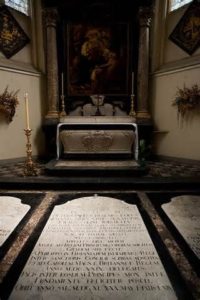
The Final Footprint – Rubens was interred in Saint Jacob’s church, Antwerp.
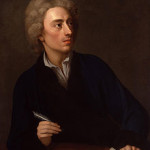 On this day in 1744, English poet, best known for his satirical verse and for his translation of Homer and for his use of the heroic couplet, Alexander Pope died at the age of 56 in his villa in Twickenham surrounded by friends.
Perhaps best known for his satirical and discursive poetry, including The Rape of the Lock, The Dunciad, and An Essay on Criticism, as well as for his translation of Homer. After Shakespeare, Pope is the second-most quoted writer in the English language, per The Oxford Dictionary of Quotations, some of his verses having even become popular idioms in common parlance (e.g., Damning with faint praise).
Pope’s poetic career testifies to his indomitable spirit in the face of disadvantages, of health and of circumstance. The poet and his family were Catholics and thus fell subject to the Test Acts, prohibitive measures which severely hampered the prosperity of their co-religionists after the abdication of James II; one of these banned them from living within ten miles of London, and another from attending public school or university. He was taught to read by his aunt and became a lover of books. He learned French, Italian, Latin, and Greek by himself, and discovered Homer at the age of six. As a child Pope survived being once trampled by a cow, but when he was 12 began struggling with tuberculosis of the spine (Pott disease), along with fits of crippling headaches which troubled him throughout his life.
In the year 1709, Pope showcased his precocious metrical skill with the publication of Pastorals, his first major poems. They earned him instant fame. By the time he was 23 he had written An Essay on Criticism, released in 1711. A kind of poetic manifesto in the vein of Horace’s Ars Poetica, the essay was met with enthusiastic attention.
The Rape of the Lock, perhaps the poet’s most famous poem, appeared first in 1712, followed by a revised and enlarged version in 1714. When Lord Petre forcibly snipped off a lock from Miss Arabella Fermor’s head (the “Belinda” of the poem), the incident gave rise to a high-society quarrel between the families. With the idea of allaying this, Pope treated the subject in a playful and witty mock-heroic epic. The narrative poem brings into focus the onset of acquisitive individualism and conspicuous consumption, where purchased goods assume dominance over moral agency.
A folio comprising a collection of his poems appeared in 1717, together with two new ones written about the passion of love. These were Verses to the Memory of an Unfortunate Lady and the famous proto-romantic poem Eloisa to Abelard. Though Pope never married, about this time he became strongly attached to Lady M. Montagu, whom he indirectly referenced in the popular poem Eloisa to Abelard, and to Martha Blount, with whom his friendship continued throughout his life.
As his health was failing, and when told by his physician, on the morning of his death, that he was better, Pope replied: “Here am I, dying of a hundred good symptoms”.
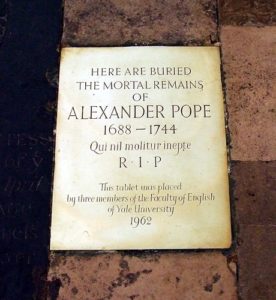 The Final Footprint – He lies buried in the nave of the Church of St Mary the Virgin in Twickenham. In his will Pope asked to be carried at his funeral by 6 of the poorest men of Twickenham, kitted out in grey mourning suits; his manuscripts & publications he left to Lord Bolingbroke “either to be preserved or destroyed”. His epitaph in Latin; Qui nil molitur inepte, in nothing was he inept.
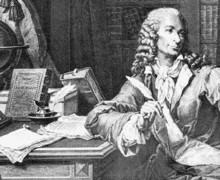 On this day in 1778, French Enlightenment writer, historian and philosopher famous for his wit and for his advocacy of civil liberties, including freedom of religion, freedom of expression, free trade and separation of church and state, Voltaire died in Paris at the age of 83. Born François-Marie Arouet in Paris either on 21 November 1694 or 20 February 1694. Voltaire was a versatile writer, producing works in almost every literary form, including plays, poems, novels, essays, and historical and scientific works. He wrote more than 20,000 letters and more than 2,000 books and pamphlets. He was an outspoken advocate, despite the risk this placed him in under the strict censorship laws of the time. As a satirical polemicist, he frequently made use of his works to criticize intolerance, religious dogma, and the French institutions of his day.
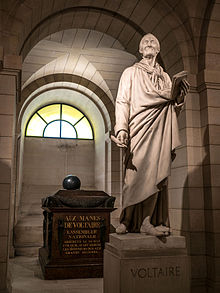 The Final Footprint – Because of his well-known criticism of the Church, which he had refused to retract before his death, Voltaire was denied a Christian burial, but friends managed to bury his body secretly at the Abbey of Scellières in Champagne before this prohibition had been announced. His heart and brain were embalmed separately. On 11 July 1791, the National Assembly of France, which regarded him as a forerunner of the French Revolution, had his remains brought back to Paris to enshrine him in the Panthéon. It is estimated that a million people attended the procession, which stretched throughout Paris. There was an elaborate ceremony, complete with an orchestra, and the music included a piece that André Grétry had composed specially for the event. A widely repeated story, that the remains of Voltaire were stolen by religious fanatics in 1814 or 1821 during the Pantheon restoration and thrown into a garbage heap, is false. Such rumours resulted in the coffin being opened in 1897, which confirmed that his remains were still present. Other notable Final Footprints at the Panthéon include: Louis Braille, Pierre and Marie Curie, Alexandre Dumas, Victor Hugo, André Malraux, Jean-Jacques Rousseau, and Émile Zola.
#RIP #OTD in 1960 poet (My Sister, Life), novelist (Doctor Zhivago), literary translator Boris Pasternak died of lung cancer in his dacha in Peredelkino near Mosscow, aged 70. Peredelkino Cemetery
#RIP #OTD in 1967 actor (The Invisible Man, The Adventures of Robin Hood, The Wolf Man, Casablanca, Kings Row, Notorious, Lawrence of Arabia) Claude Rains died from cirrhosis of the liver, aged 77. Red Hill Cemetery in Moultonborough, New Hampshire
#RIP #OTD in 1993 jazz composer, bandleader, piano and synthesizer player, poet, Sun Ra died at Princeton Baptist Medical Center, Birmingham, Alabama, aged 79. Elmwood Cemetery, Birmingham
#RIP #OTD in 2025, actress, (Major Margaret “Hot Lips” Houlihan on M*A*S*H), Loretta Swit died at her home in New York City aged 87. Cremation
Have you planned yours yet?
Follow TFF on twitter @RIPPTFF
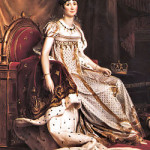 On this day in 1814, first wife of Napoléon Bonaparte, and thus the first Empress of the French, Joséphine de Beauharnais died of pneumonia in Rueil-Malmaison, four days after catching cold during a walk with Tsar Alexander in the gardens of Malmaison, at the age of 50. Born Marie Josèphe Rose Tascher de La Pagerie in Les Trois-Îlets, Martinique to a wealthy white Creole family that owned a sugar plantation. Her first husband Alexandre de Beauharnais was guillotined during the Reign of Terror, and she was imprisoned in the Carmes prison until her release five days after Alexandre’s execution. Through her daughter, Hortense, she was the maternal grandmother of Napoléon III. Through her son, Eugène, she was the great-grandmother of later Swedish and Danish kings and queens. The reigning houses of Belgium, Norway and Luxembourg also descend from her. She did not bear Napoleon any children; as a result, he divorced her in 1810 to marry Marie Louise of Austria. Joséphine was the recipient of numerous love letters written by Napoleon, many of which still exist. Her Château de Malmaison was noted for its magnificent rose garden, which she supervised closely, owing to her passionate interest in roses, collected from all over the world.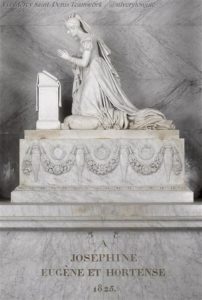


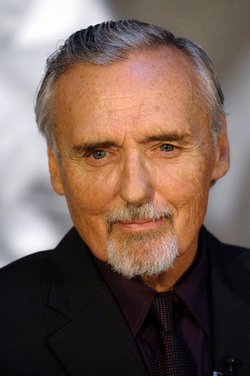 On this day in 2010, actor, screenwriter, director and photographer, Dennis Hopper, died at his home in the coastal Los Angeles district of Venice at the age of 74 from prostate cancer. Born Dennis Lee Hopper on 17 May 1936 in Dodge City, Kansas. He appeared in an impressive list of great, even iconic movies, including: as a goon in Rebel without a Cause (1955) starring James Dean; as Jordan Benedict III in Edna Ferber’s Giant (1956) with Rock Hudson, Elizabeth Taylor and James Dean; as Dave Hastings in The Sons of Katie Elder (1965) with John Wayne and Dean Martin; as Babalugats in Cool Hand Luke (1967) with Paul Newman, Strother Martin and George Kennedy; as the Prophet in Hang ’em High (1968) with Clint Eastwood; as Billy in Easy Rider (1969) which he directed and co-wrote with Peter Fonda and Terry Southern and which he starred in with Fonda and Jack Nicholson; as Moon in True Grit (1969) with John Wayne, Glen Campbell, Kim Darby, Robert Duvall and Strother Martin; as a photojournalist in Francis Ford Coppola’s adaptation of Joseph Conrad’s novel Heart of Darkness (1902), Apocalypse Now (1979) with Marlon Brando, Martin Sheen and Robert Duvall; as Frank Booth in David Lynch’s Blue Velvet (1986) with Kyle MacLachlan and Isabella Rossellini; as Shooter in Hoosiers (1986) with Gene Hackman; as Lyle from Dallas in Red Rock West (1993) with Nicholas Cage and Lara Flynn Boyle; as Clifford Worley in True Romance (1993) which was written by Quentin Tarrantino and featured Christian Slater, Patricia Arquette, Val Kilmer, Gary Oldman, Brad Pitt and Christopher Walken; as Howard Payne in Speed (1994) with Sandra Bullock and Keanu Reeves.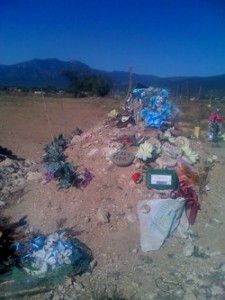
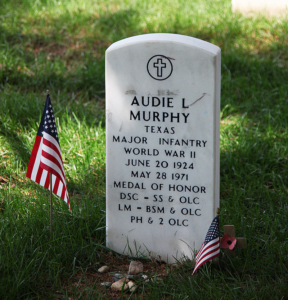
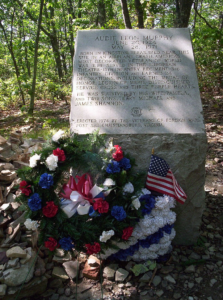
 On this day in 2012, guitarist, songwriter and singer, 7x Grammy Award winner, Doc Watson died at Wake Forest Baptist Medical Center in Winston-Salem, North Carolina at the age of 89. Born Arthel Lane “Doc” Watson on 3 March 1923 in Deep Gap, North Carolina. He was predeceased by his son Merle who died in a tractor accident at their farm. One of my favorite Guy Clark songs, “Dublin Blues”, has a line that pays tribute to Watson: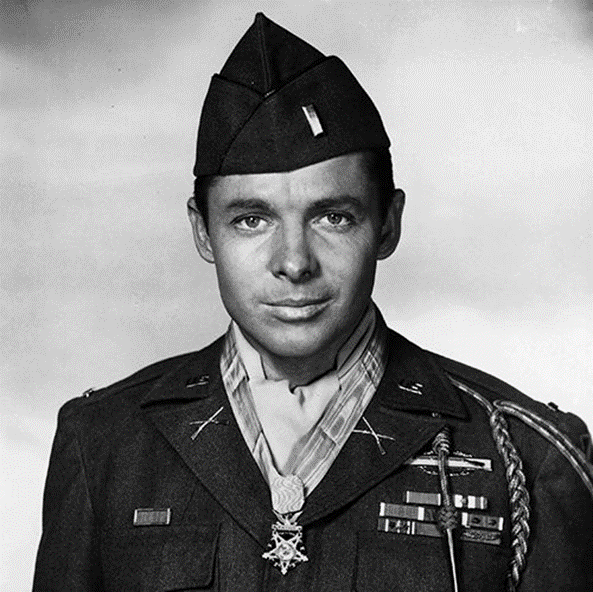


 The Final Footprint
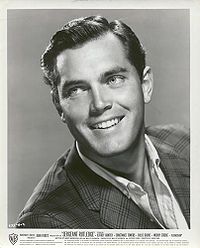 On this day in 1969, United States Navy veteran, actor Jeffrey Hunter died from a cerebral hemorrhage in Los Angeles at the age of 42. Born Henry Herman McKinnies, Jr. on 25 November 1926 in New Orleans. Hunter was cast as Martin Pawley in perhaps my all-time favorite movie, The Searchers (1956). The movie was directed by John Ford and starred John Wayne as Ethan Edwards and also featured; Vera Miles as Laurie Jorgensen, Ward Bond as Rev. Capt. Samuel Johnson Clayton, Natalie Wood as Debbie Edwards (older), and Ken Curtis as Charlie McCorry. The appeal of this movie spans generations; my oldest son is a fan. Hunter is also revered among Star Trek fans, myself included. He accepted the lead role of Captain Christopher Pike in “The Cage”, the first pilot episode of Star Trek. Hunter declined to film a second Star Trek pilot requested by NBC in 1965. Hunter was married three times; Barbara Rush (1950-1955 divorce), Joan Bartlett (1957-1967 divorce) and Emily McLaughlin (1969-1969 his death).
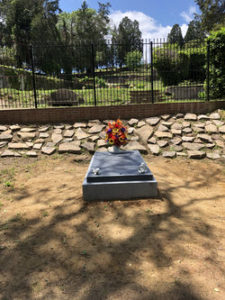
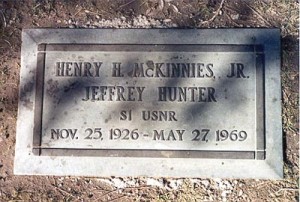 The Final Footprint – Hunter is interred in Glen Haven Memorial Park in Sylmar, California. His grave is marked by an individual flat bronze marker. His wife Emily, who played nurse Jessie Brewer on the soap opera General Hospital, was interred next to him following her death in 1991.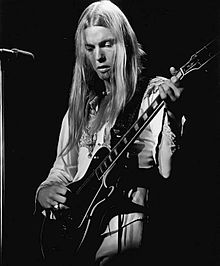

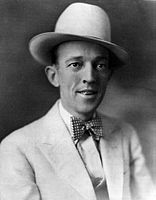 On this day in 1933, songwriter, country music pioneer and superstar, The Singing Brakeman, The Blue Yodeler, The Father of Country Music, Jimmie Rodgers, died at the Taft Hotel in New York City from tuberculosis at the age of 35. Born James Charles Rodgers on 8 September 1987 in either Meridien, Mississippi or Geiger, Alabama. Rodgers was one of the first three inductees into the Country Music Hall of Fame, along with Fred Rose and Hank Williams. Numerous artists have recorded tribute albums or his songs including; Gene Autry, Merle Haggard, Hank Snow, Lefty Frizzell, Bob Dylan, Bono, Alison Krauss & Union Station, Jerry Garcia, Dickey Betts, Dwight Yoakam, Aaron Neville, John Mellencamp, Willie Nelson, Lynyrd Skynyrd, Jerry Lee Lewis and Tompall Glaser. Rodgers reportedly influenced other artists including; Elvis, Muddy Waters, Big Bill Broonzy, Howlin’ Wolf, and Mississippi John Hurt. Of course, my favorite Rodgers song is “Blue Yodel” better known as “T for Texas”.
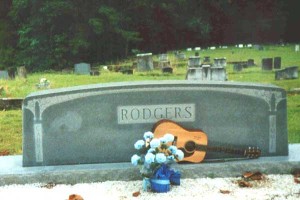 The Final Footprint – Rodgers is interred in the Rodgers family plot in Oak Grove Baptist Church Cemetery in Meridian, Mississippi. The family plot is marked by a large upright granite marker. His grave is marked by an individual raised granite marker.

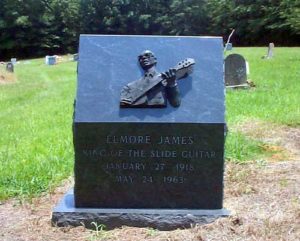 The Final Footprint
 The Final Footprint
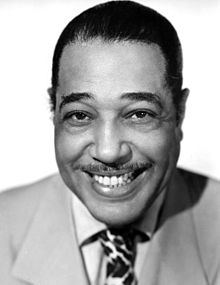 On this day in 1974, Grammy award-winning composer, pianist and big band leader, Duke Ellington died of lung cancer in New York City at the age of 75. Born Edward Kennedy Ellington on 29 April 1899 in Washington, D. C. In my opinion, one of the most prominent figures in jazz and one of the greatest composers. His music spanned other genres including blues, gospel, film scores, popular and classical. Ellington was married to Edna Thompson. Ellington was awarded the NAACP Springarn Medal, the Presidential Medal of Freedom by Richard Nixon, and The French Legion of Honor.
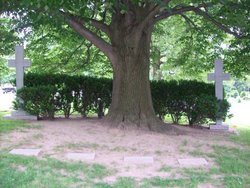 The Final Footprint – Ellington is interred in the Ellington private estate in Woodlawn Cemetery in The Bronx. The estate is marked by two large granite crosses flanking a large tree. One of the crosses has the inscription; THE LORD IS MY SHEPHERD. His grave is marked by a flat granite marker. Ella Fitzgerald said, “It’s a very sad day. A genius has passed.” Numerous memorials have been dedicated to Duke Ellington, in cities from New York (The Essentially Ellington High School Jazz Band Competition and Festival, Duke Ellington Boulevard and Duke Ellington Circle) and Washington, D. C. (The Duke Ellington School of Arts and Duke Ellington Bridge) to Los Angeles (a statue at the entrance to UCLA’s Schoenberg Hall). Many songs and albums have been written and dedicated to Ellington. My favorite tribute song is Stevie Wonder’s “Sir Duke”. Ellington was posthumously awarded a Pulitzer Prize Special Citation. Other notable Final Footprints at Woodlawn include; Irving Berlin, Miles Davis, Fiorello La Guardia, Rowland Macy, Bat Masterson, Herman Melville, LeRoy Neiman, J. C. Penney, and Joseph Pulitzer.



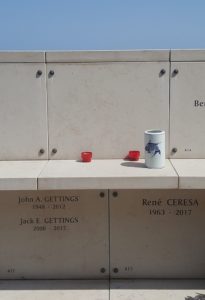
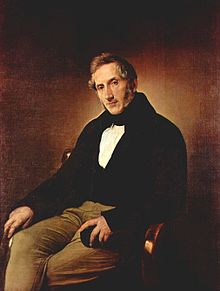
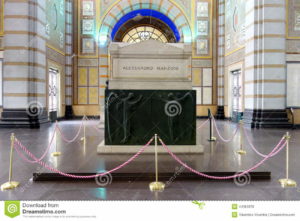 The Final Footprint – Manzoni’s funeral was celebrated in the church of San Marco with almost royal pomp. His remains, after lying in state for some days, were followed to the Cimitero Monumentale in Milan by a vast cortege, including the royal princes and all the great officers of state. But his noblest monument was Giuseppe Verdi’s Requiem, written to honour his memory.
 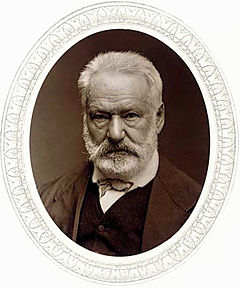 On this day in 1885, poet, playwright, novelist, essayist, visual artist, statesman, human rights activist and exponent of the Romantic movement in France, Victor Hugo died in Paris at the age of 83. Born Victor-Marie Hugo on 26 February 1802 in Besançon in the region of Franche-Comté. He was revered as a towering figure in literature and as a statesman who shaped the Third Republic and democracy in France. Outside France, his best-known works are the novels Les Misérables and Notre-Dame de Paris (known in English as The Hunchback of Notre-Dame). In France, Hugo is best known for his poetry, particularly Les Contemplations and La Légende des siècles, as well as for his novels. Hugo married Adèle Foucher (1822-1868 her death). Hugo had a great impact on the music world through the inspiration that his works provided for composers of the 19th and 20th century. Among the many operas based on his works are; Donizetti’s Lucrezia Borgia (1833), Verdi’s Rigoletto (1851) and Ernani (1844), and Ponchielli’s La Gioconda (1876). It was during the production of Donizetti’s Lucrezia Borgia, that Hugo met one of the performers, Juliette Drouet. She would leave her theatrical career to devote her life to Hugo as his lover, secretary and travelling companion. As I type this from my library, Hugo’s books, Les Misérables and The Hunchback of Notre Dame are within arms reach. Two of my favorite books.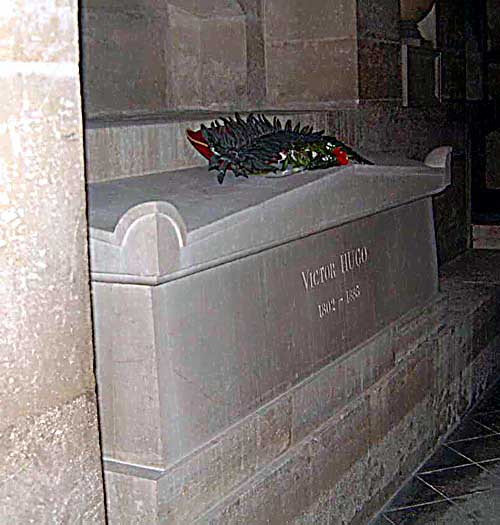
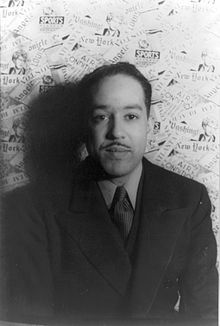
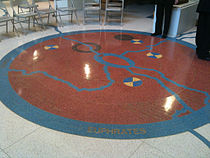 The Final Footprint – Hughes was cremated and his cremains are interred beneath a floor medallion in the middle of the foyer in the Arthur Schomburg Center for Research in Black Culture in Harlem. It is the entrance to an auditorium named for him. The design on the floor is an African cosmogram titled Rivers. The title is taken from, “The Negro Speaks of Rivers”. Within the center of the cosmogram is the line: “My soul has grown deep like the rivers”. The Beinecke Rare Book and Manuscript Library at Yale University holds the Langston Hughes papers (1862–1980) and the Langston Hughes collection (1924–1969) containing letters, manuscripts, personal items, photographs, clippings, artworks, and objects that document the life of Hughes. The Langston Hughes Memorial Library on the campus of Lincoln University, as well as at the James Weldon Johnson Collection within the Yale University also hold archives of Hughes’ work.
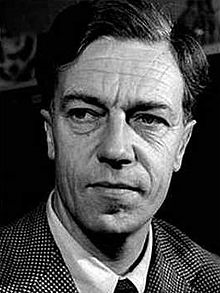 On this day in 1972, poet, Poet Laureate of the United Kingdom from 1968 until his death in 1972, father of actor Daniel Day-Lewis, Cecil Day-Lewis died from pancreatic cancer, aged 68, at Lemmons, the Hertfordshire home of Kingsley Amis and Elizabeth Jane Howard, where he and his family were staying. Born in Ballintubbert, Athy/Stradbally border, County Laois (formerly known as Queen’s County), Ireland. Day-Lewis also wrote mystery stories under the pseudonym of Nicholas Blake. He married twice; Constance Mary King (1928–1951 divorce) and Jill Balcon (1951–1972 his death).
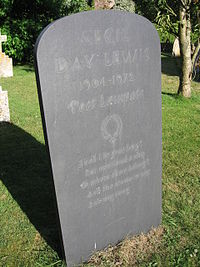 The Final Footprint – Day-Lewis was a great admirer of Thomas Hardy, and had arranged to be buried as close as possible to the author’s grave in Stinsford churchyard, Dorset, south west England.
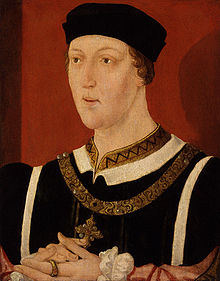 On this day in 1471, King of England from 1422 to 1461 and again from 1470 to 1471, and disputed King of France from 1422 to 1453, Henry VI died in the Wakefield Tower of the Tower of London at the age of 49 of unknown cause. Born on 6 December 1421 at Windsor Castle. Henry was the only child and heir of King Henry V. He succeeded to the throne as King of England on his father’s death on 31 August 1422 at the age of nine months: the youngest person ever to succeed to the English throne. Two months later, on 21 October 1422, he became titular King of France upon his grandfather Charles VI‘s death in accordance with the Treaty of Troyes of 1420. His mother, Catherine of Valois, was then 20 years old. As Charles VI’s daughter, she was viewed with considerable suspicion by English nobles and prevented from playing a full role in her son’s upbringing. Contemporaneous accounts described him as peaceful and pious, not suited for the dynastic wars, such as the Wars of the Roses, which commenced during his reign. His periods of insanity and his inherent benevolence eventually required his wife, Margaret of Anjou, to assume control of his kingdom, which contributed to his own downfall, the collapse of the House of Lancaster, and the rise of the House of York. After a violent struggle between the houses of Lancaster and York, during which the Duke of York was killed by Margaret’s forces on 30 December 1460, Henry was deposed and imprisoned on 4 March 1461 by the Duke of York’s son, Edward of York, who became king, as Edward IV. By this point, Henry was suffering such a bout of madness that he was apparently laughing and singing while the Second Battle of St Albans raged, which secured his release. But Edward was still able to take the throne, though he failed to capture Henry and his queen, who fled to Scotland. During the first period of Edward IV’s reign, Lancastrian resistance continued mainly under the leadership of Queen Margaret and the few nobles still loyal to her in the northern counties of England and Wales. Henry, who had been safely hidden by Lancastrian allies in Scotland, Northumberland and Yorkshire was captured by King Edward in 1465 and subsequently held captive in the Tower of London. Queen Margaret, exiled in Scotland and later in France, was determined to win back the throne on behalf of her husband and son. By herself, there was little she could do. However, eventually Edward IV had a falling-out with two of his main supporters: Richard Neville, Earl of Warwick, and his own younger brother George, Duke of Clarence. At the urging of King Louis XI of France they formed a secret alliance with Margaret. After marrying his daughter to Henry and Margaret’s son, Edward of Westminster, Warwick returned to England, forced Edward IV into exile, and restored Henry VI to the throne on 30 October 1470. However, by this time, years in hiding followed by years in captivity had taken their toll on Henry. Warwick and Clarence effectively ruled in his name. Henry’s return to the throne lasted less than six months. Warwick soon overreached himself by declaring war on Burgundy, whose ruler responded by giving Edward IV the assistance he needed to win back his throne by force. Edward IV returned to England in early 1471, after which he was reconciled with Clarence and killed Warwick at the Battle of Barnet. The Yorkists won a final decisive victory at the Battle of Tewkesbury on 4 May 1471, where Henry’s son Edward was killed. Henry may have been murdered upon the orders of Edward IV.
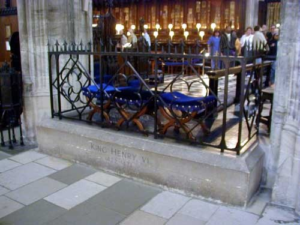 The Final Footprint – Henry VI was originally buried in Chertsey Abbey; then, in 1485, his body was moved to St George’s Chapel, Windsor Castle, by Richard III. In 1590 William Shakespeare wrote a trilogy of plays about the life of Henry VI: Henry VI, Part 1, Henry VI, Part 2, and Henry VI, Part 3. His dead body and his ghost also appear in Richard III. Shakespeare’s portrayal of Henry is notable in that it does not mention the King’s madness. This is considered to have been a politically-advisable move so as to not risk offending Elizabeth I whose family was descended from Henry’s Lancastrian family. Instead Henry is portrayed as a pious and peaceful man ill-suited to the crown. He spends most of his time in contemplation of the Bible and expressing his wish to be anyone other than a king. Shakespeare’s Henry is weak-willed and easily influenced allowing his policies to be led by Margaret and her allies, and being unable to defend himself against York’s claim to the throne. Other notable final footprints at St. George’s Chapel include: Edward IV, Edward VII, Jane Seymour, Henry VIII, Charles I, George III, George IV, William IV, and George V.
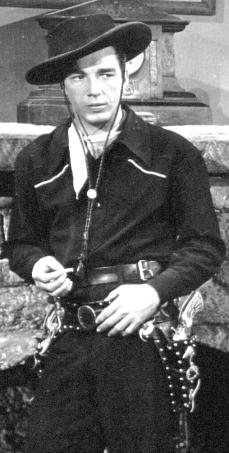 On this day in 1996, western motion picture star Lash LaRue died of emphysema at St Joseph’s Hospital in Burbank, California at the age of 74. Born Alfred LaRue on 14 June 1921 in Gretna in suburban Jefferson Parish near New Orleans, Louisiana, of Cajun ancestry. Known for his exceptional skill with a bull whip which he used to bring down the bad guys in his movies; thus his nickname, Lash. LaRue taught Harrison Ford how to use a whip for the Indiana Jones movies.